
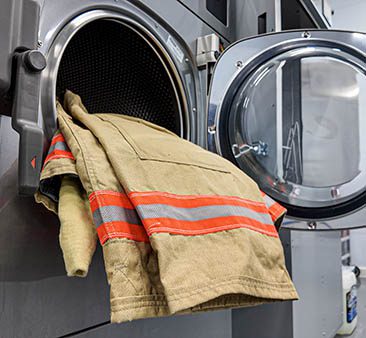
For nearly two decades, PPE and SCBA program requirements in the fire service lived in two separate documents: NFPA 1851 (structural PPE care and maintenance) and NFPA 1852 (SCBA selection, care, and maintenance). Departments were forced to navigate parallel standards, duplicate definitions, inconsistent terminology, and fragmented compliance responsibilities.
That era is over.
With the release of NFPA 1850, the National Fire Protection Association has merged both standards into a single, unified, end‑to‑end lifecycle framework for the gear that protects firefighters from the most dangerous environments on earth. And while some are calling it a “revision,” it’s much more than that — it’s a structural overhaul of how departments must manage protective ensembles.
This article breaks down what actually changed, why it changed, and why NFPA 1850 is now the fire service’s recognized standard of care.
Why NFPA Consolidated 1851 & 1852
Before NFPA 1850, fire departments were expected to manage two completely separate standards for equipment that firefighters use together on every single call. NFPA itself acknowledged the inefficiency. In recent years, their Standards Council began a larger initiative to consolidate and streamline more than 100 emergency service standards into cohesive families. One result was the unification of turnout gear and SCBA into a single PPE‑and‑respiratory protection lifecycle program.
The Problem With Two Standards
Departments frequently found themselves struggling with:
- Conflicting definitions of “cleaning,” “advanced cleaning,” and “decontamination.”
- Inconsistent inspection cycles across PPE vs. SCBA.
- Different documentation requirements for items used in the same environment.
- Duplication of recordkeeping, training, and compliance auditing.
- Growing scientific evidence that PPE and SCBA contamination pathways are interconnected, requiring unified control measures.
NFPA 1850 solves those conflicts by finally treating the ensemble as one integrated life‑safety system, not two unrelated categories of equipment.
What’s New in NFPA 1850: The Big Changes
1. One Standard, One Program, One Chain of Responsibility
The most significant shift is administrative. NFPA 1850 requires departments to operate a single PPE Ensemble Program covering:
- Turnout coats and pants
- Hoods
- Gloves
- Boots
- Helmets
- SCBA
- PASS and integrated electronics
This forces departments to eliminate silos and manage contamination control, inspection, repair, cleaning, and retirement with unified processes and documentation.
2. Unified Cleaning & Decontamination Requirements
In the past, turnout gear and SCBA cleaning guidance came from different documents. NFPA 1850 consolidates all definitions, including:
- Routine cleaning
- Advanced cleaning
- Special cleaning
- Sanitization
- Decontamination
This matters, because modern contamination research shows:
- PAHs, VOCs, and PFAS accumulate on both PPE and SCBA components.
- Firefighters absorb carcinogens through the skin even when SCBA is used properly.
- Cross‑contamination occurs when PPE and SCBA are stored or transported without proper cleaning.
NFPA 1850 now requires validated cleaning methods, not guesswork.
3. Verified ISP Requirements Are Stronger Than Ever
NFPA 1851 introduced Verified Independent Service Providers (ISPs). NFPA 1850 expands their role significantly.
Under the new standard:
- Verified ISPs must meet cleaning-efficacy verification thresholds.
- Departments must ensure all advanced cleaning and repair work is performed by a manufacturer or Verified ISP.
- ISPs must demonstrate measurable contaminant removal, not simply follow procedures.
This replaces subjective judgment with scientific performance criteria, mirroring contamination research from FEMA, NIOSH, and FSRI.
4. SCBA Requirements Brought Into the Fold
NFPA 1852 is now fully absorbed into 1850, bringing:
- Annual flow testing
- Cylinder hydro testing
- Breathing air quality checks
- SCBA inspection, cleaning, and repair requirements
- Technician qualification requirements
This formally recognizes what departments already knew: SCBA is PPE, and must be managed with the same rigor and traceability as turnout gear.
5. Stricter Retirement Requirements
NFPA 1850 maintains and strengthens the long‑standing 10‑year retirement rule for turnout gear, but also clarifies:
- SCBA components may have shorter manufacturer‑specified lifespans
- Electronic components must follow updated retirement criteria
- Gear must be immediately removed from service if contamination or damage compromises safety
The goal is simple: remove unsafe equipment before it fails on the fireground.
Why the Change Matters: Cancer, Liability, & Readiness
Fire service occupational cancer data is no longer debatable:
- Firefighters are 9% more likely to develop cancer
- Firefighters are 14% more likely to die from cancer
- 66% of career firefighter LODDs over nearly two decades were cancer-related
Sources: NIOSH, IAFF
Modern research shows that:
- 92% of PAHs at firefighter breathing height are vapor-phase
- PFAS compounds are prevalent in turnout gear layers
- Traditional washing removed as little as 15–40% of PAHs
Sources: NIST, FSRI, IFSI, Finnish PPE studies
NFPA 1850 is designed to close these contamination gaps and create uniformity in gear management.
Just as importantly, the legal environment is shifting. In litigation following a firefighter illness or injury, courts evaluate whether the department met the recognized standard of care. Today, that standard is NFPA 1850 — not outdated internal practices.
Failure to comply can be interpreted as:
- Negligence
- Lack of duty of care
- Lack of risk‑management oversight
For municipalities, this exposes millions in potential liability.
The Bottom Line: NFPA 1850 Is Not Optional
NFPA 1850 is the new baseline for fire service protective ensemble management.
For departments, compliance is more than a regulatory exercise:
It’s a defensive shield against occupational cancer, equipment failure, and legal risk.
For firefighters, it represents a cultural shift — one that values long-term health as much as operational performance.
For municipalities, it is an investment in liability reduction and employee protection.
This standard is not a suggestion.
It’s a necessary evolution.