
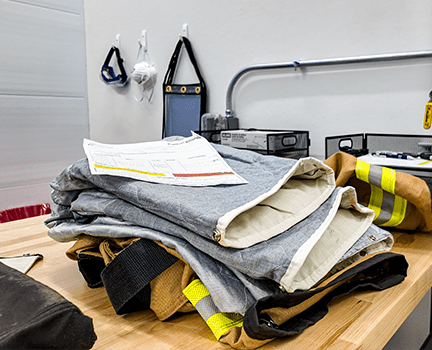
In the fire service, your Personal Protective Equipment (PPE) is your most vital lifeline. For volunteer departments balancing tight budgets and high safety standards, an Independent Service Provider (ISP) is more than a vendor—they are a critical safety partner.
Recently, Michelle from Heiman Fire ISP sat down with Jim Evans of Solution Safety and SC Products to discuss how volunteer departments can strategically utilize an ISP to protect their personnel and their bottom line.
What is an Independent Service Provider (ISP)?
An ISP is a specialized facility verified to perform advanced cleaning, inspections, and repairs on firefighting ensemble elements. While routine cleaning happens at the station, an ISP provides the technical expertise required by NFPA 1851 standards.
4 Pillars of ISP Support for Volunteer Departments
- Custom Gear Spec’ing: ISPs understand the science of fabrics. They help departments choose the right materials during the procurement phase to ensure durability and protection.
- Asset Longevity: Professional maintenance extends the service life of turnout gear, providing a better return on investment (ROI) for tax-payer funded budgets.
- Carcinogen Mitigation: Advanced cleaning processes target deep-seated toxins and carcinogens that standard laundry cycles cannot remove.
- Expert Inspections: Like a “specialist doctor” for your gear, an ISP performs the deep-dive annual inspections necessary to catch hidden failures in moisture barriers or thermal liners.
📋 Volunteer Chief’s Checklist: Evaluating Your PPE Program
Use this checklist to determine if your department is meeting safety benchmarks:
- [ ] Annual Advanced Inspection: Has every set of gear had a documented, professional inspection in the last 12 months?
- [ ] Advanced Cleaning: Is gear sent to a verified ISP after heavy exposure to products of combustion?
- [ ] NFPA 1851 Compliance: Are your maintenance records up to date for every serial number in your inventory?
- [ ] Fabric Integrity: Has your gear passed a “hydrostatic pressure test” to ensure the moisture barrier is still intact?
- [ ] Retirement Schedule: Do you have a clear 10-year retirement plan for all PPE elements?
“Think of an ISP like your doctor. You handle the minor stuff at home, but for the serious health of your gear and your crew, you need a professional checkup once a year.” — Jim Evans
Get the Most Out of Your Gear
Volunteer departments don’t have to navigate PPE maintenance alone. Partnering with an ISP ensures that your gear is not just “clean,” but combat-ready.